

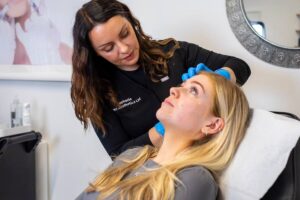
The ‘vampire facial’ has become one of those treatment names that’s more recognisable than the science behind it. It sounds dramatic, and the name has genuinely helped the treatment go viral over the years, but what it actually describes is PRP, platelet-rich plasma therapy, a treatment that uses a concentrated portion of your own blood to trigger your skin’s natural repair and collagen-building processes.
What the Vampire Facial Actually Involves
The name comes from the visible part of the process, a small blood sample is taken from your arm in the same way as a routine blood test, then spun in a centrifuge to separate out the platelet-rich plasma. That plasma is then reintroduced into the skin via a series of fine micro-injections, sometimes alongside microneedling to help it penetrate more effectively. It’s this blood-drawing step, rather than anything unusual about the treatment itself, that earned it the nickname.
What’s actually happening beneath the surface is far less dramatic than the name suggests, and considerably more interesting clinically. Platelets contain growth factors that signal your skin to repair itself, build new collagen and improve its own hydration retention. Because the plasma is entirely your own, there’s no risk of an allergic reaction to a foreign substance, which is part of why the treatment appeals to clients who are cautious about introducing synthetic products into their skin.
Why the Name Caught On
Results build gradually rather than appearing immediately, since the treatment relies on your body’s own regenerative response rather than an instant physical effect. Most clients notice improvement in skin tone, texture and dullness from around four to six weeks after each session, with continued improvement over the following months as collagen production increases. Some clients notice a mild, temporary tightness or sensitivity in the treated area for the first day or so, but this settles quickly and rarely interferes with normal activities.
It’s a treatment well suited to clients wanting to improve overall skin quality rather than address a single specific concern, and it works particularly well for fine lines, dullness and mild scarring. The same underlying treatment, applied to the scalp rather than the face, is also one of our most requested options for early hair thinning, so don’t be surprised if the conversation branches into that too if it’s something you’ve mentioned. Many clients booking for hair thinning are surprised to learn the same treatment, and the same underlying science, is behind both applications, simply delivered to a different area with a slightly different goal in mind.
What to Expect in Your Appointment
Because the appointment itself is straightforward, a blood draw followed by micro-injections, most clients are back to their normal routine immediately afterwards, with only mild, temporary redness or pinpoint marks at the injection sites. It pairs well with polynucleotides or skin boosters for clients wanting to layer regenerative treatments across a broader skin quality plan.
Book Your Vampire Facial Consultation
If the name has always intrigued you more than you understood what it actually involved, it’s worth finding out properly. Visit nessaesthetics.com to learn more about PRP at Ness Aesthetics or to book a consultation with Steph.