

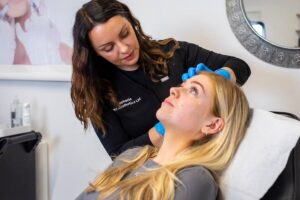

Your skin already knows how to heal itself. The question is whether it has the right conditions to do it well. PRP therapy works by concentrating the body’s own repair tools and delivering them exactly where they are needed — no synthetic substances, no structural alteration, just targeted biological support.
For patients who want gradual, natural improvement over dramatic transformation, PRP offers a compelling and well-supported path.
What PRP Actually Is
PRP stands for Platelet-Rich Plasma. It is a concentrated fraction of your own blood, prepared in-clinic and used within the same appointment.
Blood contains several components: red cells, white cells, plasma, and platelets. Platelets do more than help blood clot — they carry growth factors, which are the signaling proteins your body uses to repair damaged tissue and stimulate new cell production.
In standard circulation, platelets are diluted across your entire bloodstream. PRP concentrates them into a smaller volume of plasma, creating a far higher density of those growth factors than your skin would normally encounter.
How It Is Prepared
The process is straightforward. A small blood sample — similar in volume to a routine blood test — is drawn from your arm. The sample is placed in a centrifuge that spins at high speed, separating blood components by density.
The resulting platelet-rich layer is carefully isolated and prepared for treatment. Because everything used comes from your own body, the risk of an allergic reaction or rejection is extremely low.
What Skin Concerns PRP May Support
PRP does not change your facial structure or fill areas of volume loss. What it does is improve the quality and condition of the skin itself — which is exactly what some patients need most.
It is commonly used to address:
- Dull, tired-looking skin that lacks brightness or vitality
- Uneven texture and tone that has not responded fully to home care
- Fine lines related to skin quality rather than deep muscle movement
- Acne scarring and post-blemish marks, where cell renewal support is particularly beneficial
- Thinning or fragile skin that needs structural reinforcement from within
- Scalp health, where the same regenerative principles support hair follicle function
The improvement is gradual. Most patients notice changes in texture and radiance within a few weeks, with more visible firming and tonal evenness developing over the following months.
Why Some Patients Prefer It
Not every patient wants the most intervention-heavy option available. Some people are drawn to treatments that feel proportionate — targeted support rather than significant alteration.
PRP suits that mindset well. It works with what your skin is already capable of, encouraging it to function more like healthier, younger skin rather than replacing or overriding its natural behavior.
It also pairs well with other treatments. Many patients include PRP as part of a broader skin health plan, using it to build a stronger baseline alongside other procedures.
Book a Consultation at Ness Aesthetics
If PRP sounds like the right fit for where your skin is right now, the next step is a personal consultation. At Ness Aesthetics in Stourport, every recommendation is built around your individual skin, concerns, and goals — not a one-size-fits-all approach.
Book your consultation with Ness Aesthetics today and find out whether PRP is the right treatment for you.