

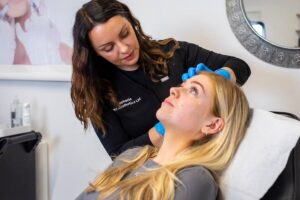
Dermal fillers are one of the most requested treatments in aesthetics — and, in much of the UK, still one of the least regulated. It’s currently possible for someone with little to no medical training to legally inject filler outside a clinical setting, which is a large part of why we regularly see patients who’ve had a difficult experience elsewhere. This guide is the checklist we’d want a friend or family member to use before booking anywhere, not just with us.
Why This Still Catches People Out
Filler is a prescription-free product for hyaluronic-acid formulations, which means the barrier to offering it commercially is lower than most patients assume. A polished social media page and a diary full of appointments don’t tell you anything about someone’s medical training, insurance, or what happens if something goes wrong — which is exactly the information that matters most.
Eight Questions to Ask Before You Book
- Are they medically qualified and registered — as a nurse, doctor, or dentist — and can they give you a registration number you can check yourself on the NMC, GMC, or GDC register?
- Is the clinic itself registered with the relevant regulator for the procedures it offers (for example, CQC registration in England for certain treatments)?
- Do they carry out a proper, separate medical consultation before treatment day, rather than assessing and injecting in the same rushed appointment?
- Can they safely access and administer hyaluronidase — the enzyme used to dissolve hyaluronic-acid filler — if a complication occurs?
- Will they tell you exactly which product and brand they’re using, and why?
- Do they hold insurance that specifically covers the treatment being performed?
- Can they show you genuine, unedited before-and-after images of their own patients, not stock or supplier photos?
- Do they offer a follow-up review appointment and a clear process for managing complications if needed?
Red Flags to Walk Away From
- Treatment offered the same day as a flash-sale post or a same-day social media DM, with no proper consultation first.
- No medical history questions asked before you’re on the treatment couch.
- Pressure to add “extra” filler on the day, beyond what was discussed and agreed.
- Reluctance or inability to confirm registration or insurance when asked directly.
- Treatment carried out in a home setting or pop-up event with no clinical governance in place.
What This Looks Like at Ness Aesthetics
Stephanie Ness is an Aesthetic Nurse Prescriber (RN, DipHE), a member of the BACN, NMC-registered, and Ness Aesthetics is a CQC registered clinic. Every filler consultation is separate from treatment, medical history is taken in full, and — because complications can happen with any practitioner, however experienced — we’re equipped and experienced in safely dissolving filler when it’s needed, including for patients who were treated elsewhere first.
If You’ve Already Had Filler and You’re Worried About It
If you’re dealing with lumps, asymmetry, or filler that simply doesn’t look right, you’re not stuck with it. Our guides on spotting the early signs of a problem and on how filler dissolving actually works are a good place to start, and a consultation with Stephanie about dissolving can talk you through your options honestly.
Frequently Asked Questions
Is dermal filler ever completely reversible?
Hyaluronic-acid fillers can usually be dissolved using hyaluronidase, which is one reason it’s worth confirming your practitioner has access to it and experience using it.
How do I actually check if someone is a registered nurse or doctor?
You can search the NMC register (nurses) or the GMC register (doctors) directly using the name they give you — a genuine registered professional will have no issue with you doing this.
What’s the difference between “qualified” and “medically regulated”?
“Qualified” can simply mean someone has completed a short training course; “medically regulated” means they’re a nurse, doctor, or dentist accountable to a statutory professional body such as the NMC or GMC. The second is the one that matters most for safety.
Can I ask to see a practitioner’s insurance certificate?
Yes, and a reputable practitioner will be happy to show you evidence of appropriate insurance for the treatment you’re having.
Considering filler, or unhappy with filler you’ve already had? Book a consultation with Stephanie for an honest, medically-led assessment.
Reviewed by Stephanie Ness, Aesthetic Nurse Prescriber (RN, DipHE) — BACN member, NMC-registered, Clinical Director at Ness Aesthetics, Stourport. CQC registered clinic. Over 10 years’ experience in aesthetic medicine and 15+ years’ NHS surgical nursing experience.