

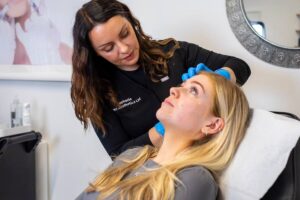
The “vampire facial” — platelet-rich plasma (PRP) applied to the skin, often alongside microneedling — has become one of the most talked-about treatments in aesthetics. Most of what’s written about it focuses on the hype; far fewer articles cover what actually happens to your skin in the days that follow, which is usually what our patients want to know most once they’ve booked in.
A Quick Recap: What Happens During a PRP Facial
A small blood sample is taken and spun in a centrifuge to separate out the platelet-rich plasma — the part of your blood richest in growth factors. This is then reapplied to the skin, usually via fine microneedling, so those growth factors can support the skin’s own repair and collagen production. If thinning hair is more of a concern than skin quality, we also offer PRP for hair loss using the same principle.
Day 0 — Straight After Your Appointment
Expect redness similar to mild sunburn, and if microneedling was used, some pinpoint marks or slight swelling. Your skin may feel warm and tight. Avoid touching or picking at the treated area, and skip makeup for the rest of the day.
Days 1–2
Redness usually starts to settle. Skin can feel dry or tight — stick to a gentle cleanser and a simple, fragrance-free moisturiser, and wear SPF daily. Hold off on active ingredients like retinol or exfoliating acids until your skin has fully recovered.
Days 3–5
Some mild flaking or light peeling is normal as the skin renews itself — resist the urge to pick or exfoliate this away and let it shed naturally.
One to Two Weeks
This is typically when patients start noticing brighter, more even-looking skin. It’s also a reasonable point to gradually reintroduce your normal skincare routine, one product at a time.
What’s Normal vs When to Contact the Clinic
Mild swelling, bruising, and tightness in the first few days are all expected. It’s not normal to have increasing pain, heat, or discharge more than 48 hours after treatment, or swelling that’s still getting worse after a week — if that happens, contact the clinic rather than waiting it out.
How Many Sessions, and When to Expect Results
Most patients have a short course, spaced several weeks apart, with visible improvements building over the following months as new collagen forms — this is a cumulative treatment, not a single-visit transformation.
Frequently Asked Questions
Can I wear makeup after a PRP facial?
We recommend waiting until the day after treatment, once any pinpoint marks have settled, and always using clean brushes/applicators.
Is a PRP facial painful?
Most patients find it uncomfortable rather than painful, particularly if microneedling is included; numbing cream is used beforehand.
How is this different from microneedling alone?
Microneedling alone creates controlled micro-injury to stimulate repair; adding PRP delivers your own concentrated growth factors into that same process, which is why the two are often combined.
Can I combine PRP with polynucleotides or skin boosters?
Sometimes, as part of a longer-term plan — this is exactly what we’ll map out together at your consultation rather than combining everything in one visit.
Curious whether a PRP facial fits your skin goals? Book a consultation with Stephanie to talk it through properly first.
Reviewed by Stephanie Ness, Aesthetic Nurse Prescriber (RN, DipHE) — BACN member, NMC-registered, Clinical Director at Ness Aesthetics, Stourport. CQC registered clinic. Over 10 years’ experience in aesthetic medicine and 15+ years’ NHS surgical nursing experience.